EBook Cover Design Template: Your Professional Look, Simplified
Let’s be honest: judging a book by its cover isn’t just a saying, it’s the reality of the marketplace. Whether you are a novelist, a business consultant, or a blogger compiling your best work, the visual presentation of your digital product is your first handshake with a potential reader. A great cover establishes credibility instantly. It tells the audience that you take your work seriously, and that what lies inside is worth their time. However, creating that professional look from scratch can be daunting. Not everyone has the budget for a freelance designer, nor the time to master complex software like Adobe Photoshop or InDesign just to get a single image ready for Amazon KDP or Gumroad.
This is where the EBook Cover Design Template enters the conversation, offering a bridge between high-end design and accessibility. This isn't just a static image; it is a dynamic tool designed to give you full creative control without the steep learning curve. We are talking about a premium design asset that leverages the power of Canva, allowing you to manipulate professional layouts right in your web browser. It eliminates the need for installing heavy software or purchasing expensive licenses for premium fonts. You simply purchase, open the PDF, click the link, and the template is copied directly to your account. It is a modern typography solution for the busy creator.
Understanding the Anatomy of a Great Cover
When you first open an EBook Cover Design Template, you aren't just seeing a pretty picture. You are looking at a carefully constructed visual hierarchy. Good design relies on the interplay between different elements—the contrast between a bold display font and a clean sans serif font, the balance of negative space against imagery, and the psychology of color. A high-quality template captures this balance. It provides a pre-arranged structure where the eye is naturally drawn to the title first, then the subtitle, and finally the author name.
The visual personality of these templates varies, but they share a common goal: professionalism. You might find a template that leans into modern typography with bold, geometric shapes and stark contrast, perfect for a tech startup or a productivity guide. Alternatively, you could select a design that utilizes a sophisticated serif font paired with elegant spacing, ideal for fiction, memoirs, or lifestyle branding. The "personality" of the cover is the silent ambassador of your content. A playful, handwritten font style suggests creativity and approachability, while a rigid, sans serif style suggests authority and efficiency.
What makes this specific offering stand out is the flexibility it affords. You are not locked into the designer's original vision. The instruction set is clear: Edit text, change fonts, font color & size, upload your own images and logo, move, add, remove, rotate, scale & edit all elements. This means the template is merely a starting point—a robust framework that you can bend to fit your specific brand identity.
Practical Application: Beyond the Bookshelf
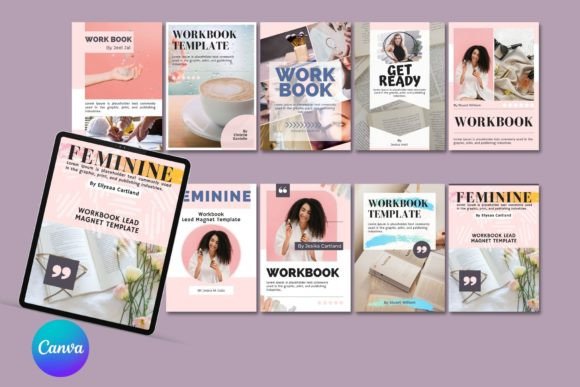
While the name implies a specific use case, the utility of an EBook Cover Design Template extends far beyond just digital books. In the current content landscape, the "cover" is often the first thing a user sees on a landing page, a social media feed, or an email header. Entrepreneurs and small business owners often use these templates to create high-value lead magnets—PDF guides offered in exchange for an email address. In this context, the cover acts as a "hero image." It needs to look substantial and valuable to justify the exchange.
For content creators and marketers, these templates are invaluable for creating cohesive branding across different platforms. Imagine you are launching a course. You can use the EBook Cover Design Template to create the course workbook, but also adapt it to create matching social media graphics for Instagram or Pinterest. Because the elements are editable, you can maintain the same color palette and typography across your entire launch campaign. This consistency builds recognition. When a follower sees that specific shade of blue or that unique display font style, they will immediately associate it with your brand.
Furthermore, the commercial aspect cannot be ignored. Many templates come with licensing that allows you to use them for commercial projects. This is a massive advantage for freelancers or agencies who need to produce mockups for clients. Instead of building a design from zero for a pitch, you can present a polished concept in minutes. The ability to share your workbook with the world also facilitates collaboration. If you are working with a co-author or a client, you can simply send them a view-only or edit link, streamlining the feedback process significantly.
Mastering the Tool: Canva as Your Creative Studio
The effectiveness of this product relies on the underlying platform: Canva. It is worth noting that while Canva is user-friendly, the instruction that "basic knowledge of Canva is needed" is important. You don't need to be a graphic designer, but you should be comfortable with the digital environment. This means understanding layers (how to bring an element to the front or send it to the back), grouping items, and managing the transparency of images.
The real power of using an EBook Cover Design Template in Canva lies in the asset library. While you can upload your own images, you also have access to Canva’s vast library of stock photography and elements. If the template features a placeholder image of a mountain, but your book is about oceanography, you can easily swap it out. You can search for "ocean" directly within the editor and drag a high-resolution image into the frame. This drag-and-drop functionality turns the design process into something that feels more like arranging furniture than technical engineering.
However, a word of advice on typography: while the template allows you to change fonts, do so with caution. The original designer likely chose specific font pairings for a reason. A heavy, bold header usually pairs well with a lighter, thinner body text to create contrast. If you swap out the header font for something too decorative, and use the same style for the body text, you risk creating visual chaos. Stick to the established hierarchy. If you change the typeface, ensure that the new sans serif font or serif font maintains the same "weight" and spacing as the original to preserve the readability.
Finalizing Your Design: Testing and Exporting
Once you have customized your EBook Cover Design Template with your own colors, images, and text, the work isn't quite done. A professional designer always tests their work. You need to evaluate the "thumbnail test." In the digital world, your cover will rarely be seen at full size. It will be a tiny square on a smartphone screen or a small listing on a website. Zoom out on your screen or shrink the window. Can you still read the title? Is the central image clear? If the text becomes illegible when small, you may need to increase the font size or choose a bolder typeface.
Check the visual hierarchy one last time. Does the eye flow naturally from the title to the subtitle? Are there any elements that look out of place or "floating" awkwardly? Since you have the power to move and scale elements, use it to tighten up the composition. Sometimes, simply reducing the size of the author name or increasing the spacing between letters (tracking) can elevate a design from "homemade" to "high-end."
Ultimately, this EBook Cover Design Template is more than just a file; it is a strategy for efficiency. It respects the reality that most creators want to spend their time writing, marketing, or building their business, not wrestling with bezier curves and clipping masks. By providing a high-quality starting point that is fully customizable, it empowers you to present your work with the visual authority it deserves, ensuring that your first impression is a lasting one.