Taxiber: A Design System for Modern Taxi Booking Apps
In the crowded marketplace of mobile applications, a first impression is often the only impression you get. For a service-based app like a taxi booking platform, that initial glance at the screen determines whether a user feels confident, confused, or completely disengaged. This is where thoughtful design moves from a nice-to-have to a core business requirement. The Taxiber - Taxi Booking Application Desig UI kit enters this space not as a simple collection of screens, but as a comprehensive visual language designed to solve real problems for both users and the businesses behind the app.
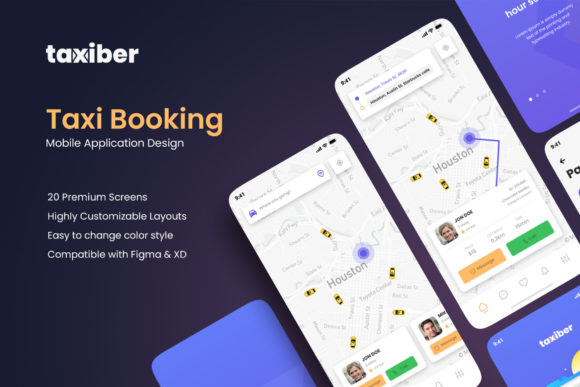
At its core, Taxiber is a meticulously crafted package of 19 PSD files. Think of it less as a template and more as a foundational toolkit. Its visual personality is built on clarity and modern efficiency. The design leans into a clean, contemporary aesthetic that prioritizes the user's immediate need: getting from point A to point B without friction. You won't find cluttered interfaces or confusing navigation here. Instead, the style emphasizes intuitive layouts, ample white space, and a visual hierarchy that guides the eye naturally to the most critical action on any given screen—whether that's confirming a pickup location, viewing fare estimates, or rating a driver.
Beyond the Mockup: Where This Design System Truly Shines
The real value of a resource like Taxiber isn't just in its polished look, but in its adaptability and the problems it helps you avoid. For designers and agencies, it's a significant accelerator. Instead of spending days building foundational screens for a client's ride-hailing pitch, you can start with a robust, professional framework and immediately focus your creative energy on customizing it to the client's specific brand identity—tweaking the color palette, swapping in their logo, and adjusting the copy. This practical approach respects both your time and the client's budget.
For entrepreneurs and startup founders, it serves as a powerful communication and validation tool. When you're explaining your app concept to potential investors, developers, or early team members, showing them a static PDF or a verbal description leaves too much to the imagination. Presenting a high-fidelity, interactive-feeling prototype built from the Taxiber files allows everyone to understand the user flow, the content hierarchy, and the overall experience you're envisioning. It turns an abstract idea into something tangible that can be critiqued, refined, and ultimately built with greater precision.
Practical Applications Across Industries
While its primary context is taxi booking, the principles and components within the kit are surprisingly versatile. The clean sans-serif typography, the iconography, and the card-based layouts are hallmarks of modern web design and app interfaces across many sectors. Consider how the map integration screens, the user profile sections, or the booking confirmation modals could be adapted for a food delivery service, a courier app, or even a personal driver service. The design's strength lies in its logical structure, which can be repurposed for any on-demand service model.
- For Marketers and Content Creators: Use the screens as high-quality visuals for website banners, social media campaigns, or pitch decks to illustrate a tech-forward service concept.
- For UI/UX Educators and Students: Deconstruct the files to study how a professional handles user flows, responsive design elements, and consistent styling across an entire application.
- For Small Business Owners: If you're developing a niche transport service (like for senior citizens or corporate clients), the kit provides a professional starting point that ensures your platform looks credible from day one.
Making It Work: Practical Guidance for Your Project
Adopting any design asset requires a strategic approach. Simply using the files as-is will result in a generic product. The goal is to leverage the system to build something uniquely yours. Here’s how to approach integrating Taxiber effectively.
First, evaluate the project fit. Scrutinize the 19 files. Does the visual tone align with your brand's personality? If your brand is playful and youthful, the clean professional look of Taxiber might need significant color and typographic adjustments. If your brand is all about premium, executive transport, the kit's clean lines could be a perfect match with just a color shift to deeper, more luxurious hues. Don't force a style; ensure the underlying structure supports your vision.
Next, test your brand elements within the system. This is a critical step. Take your brand's primary color and apply it to the main call-to-action buttons. How does it look against the chosen background? Does it maintain sufficient contrast for accessibility? Place your logo in the header area. Does it scale well? Does the existing typography complement or clash with your logo's typeface? The Taxiber - Taxi Booking Application Desig files are built to be customizable, so this testing phase is where you discover if the marriage between your brand and the UI kit will be harmonious.
Pay close attention to readability and visual hierarchy. The kit likely uses a thoughtful font pairing—perhaps a bold, clean sans-serif font for headings and a highly legible one for body text. If you change the fonts, test them rigorously on various screen sizes. Is the address text in the "Where to?" field easy to read at a glance? Are the fare details and time estimates immediately clear? In a taxi app, clarity isn't just aesthetic; it's functional. A user stressed about being late needs information they can parse in seconds.
Finally, understand the licensing. Since this is a premium font and design kit, the license will dictate how you can use it. Typically, such assets are licensed for use in a single end product (your app) for a single client. If you're an agency, you'd likely need a separate license for each client project you use it for. Read the terms carefully to ensure your use is compliant, especially if the project is commercial.
The Taxiber UI kit is more than a collection of pretty screens. It's a thoughtfully assembled starting point that acknowledges the complex demands of modern app design. It provides the structure, the consistency, and the professional polish that can help your taxi booking application—or any service-based app—stand out for the right reasons: intuitive use, clear communication, and a seamless user experience. By using it as a foundation rather than a final product, you empower yourself to build something that is both visually compelling and genuinely useful for your audience.